Equipment
Equipment
Filters
Basic function
These devices are responsible for mechanically removing impurities from pool water and are an essential part of every pool – without filters, it is very difficult to keep the water clean for more than 10–15 days.
Standard sand filters
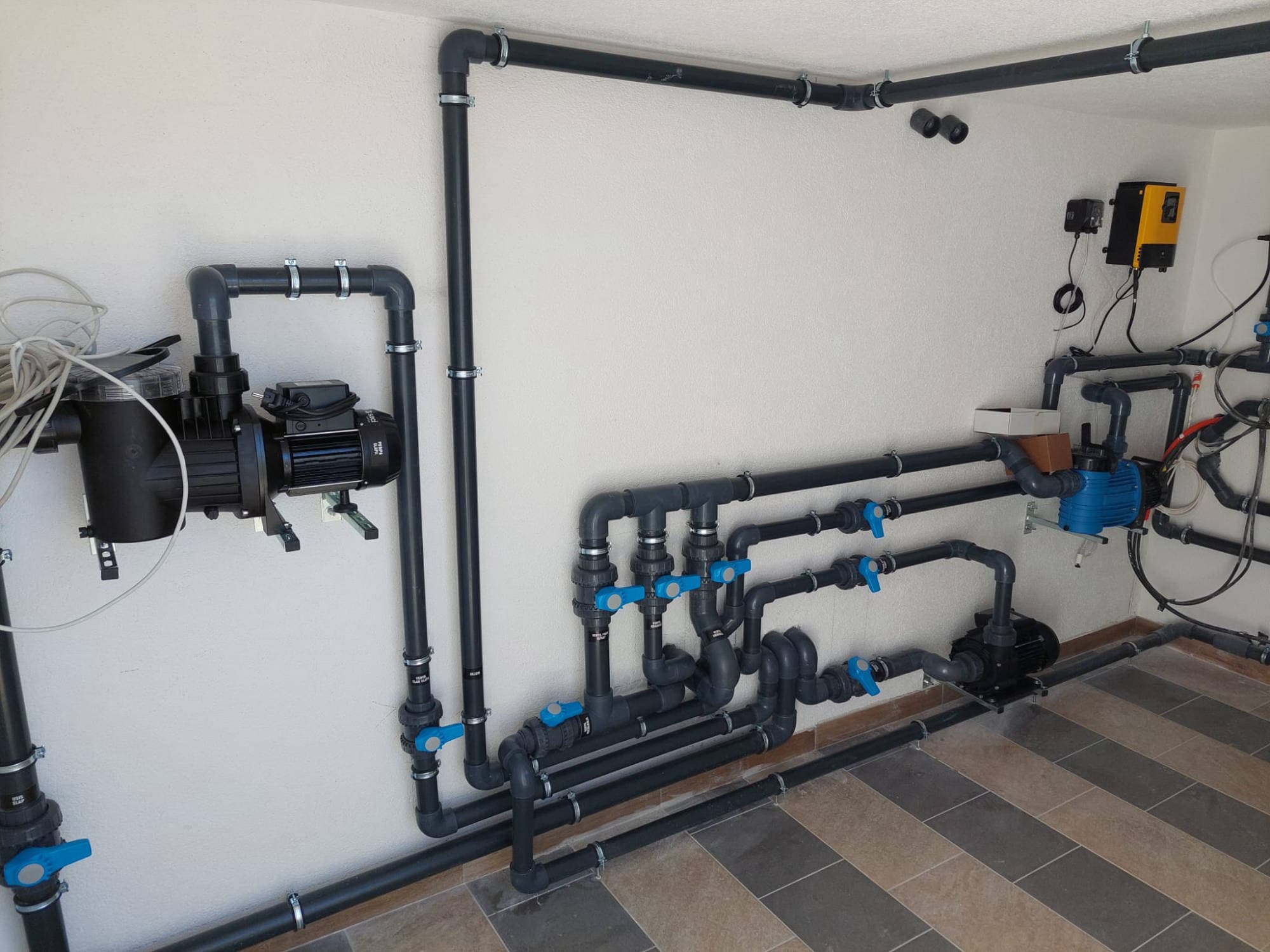
Standard sand filters, which are the most commonly used filtration devices for private and public pools, consist of the filter housing (sealed container) filled with quartz sand, glass-mineral or similar media, a PVC pipeline for water distribution, a PVC collector that returns filtered water back to the pool via the circulation pump, a 4-way or 6-way valve, and the circulation pump.
Filter materials
- polypropylene – these are inexpensive filters of somewhat lower quality, but if chosen from a quality manufacturer, they are quite suitable for private, especially above-ground pools
- injected thermoplastic – very high-quality filters, offering the best price-to-performance ratio for private pools
- laminated polyester – quality filters with excellent aesthetics, also used for small public pools
- polyester – among the highest quality filters due to strength and reliability, used for the largest public pools, including diameters over 3m
- stainless steel – exceptional mechanical strength, but increasingly less used due to high cost and the rising quality of alternative materials
Filtration quality
Besides the quality of the filter construction itself, even more important is the filtration performance, which depends on the filter's capacity – the tank diameter and media height. This means that for better water filtration, a larger filter is needed. The appropriate pump is then selected proportionally to the filter's capacity.
Filter media
The media inside the filter is also very important for quality pool water filtration. Beyond standard quartz sand, activated carbon or anthracite used in public pools, newer and higher-quality options have emerged, such as recycled glass, honeycomb polyethylene media, and what we consider the most effective – glass media coated with a silver layer using nanotechnology. This not only mechanically filters but also provides biochemical and oxidative effects on the pool water.
Filter types by media
- standard 'sand' filters filled with quartz sand, recycled glass, anthracite, polyethylene honeycomb cells, glass beads enriched with silver or titanium, etc.
- filters with diatomaceous earth
- ‘cartridge’ filters with standard or special 'nanofiber' elements that block particles larger than 5–8 µ compared to 20 µ for standard cartridges
- bag filter systems
Frequently asked questions
Why does a pool need a filter?
The filter mechanically removes dirt from the pool water. Without one it is very hard to keep the water in good condition for more than 10–15 days.
Which filter should I choose for a private pool?
For private pools, injection-moulded thermoplastic filters offer the best balance of price and quality. Filtration quality depends on the filter’s capacity — vessel diameter and media depth — and the pump is sized to match that capacity.
How can I extend the swimming season?
By installing pool heating — a heat exchanger, an electric heater or a heat pump. Heat pumps take heat from the air and are among the most cost-effective systems on the market.

You deserve the perfect pool
Contact us and let's turn your dream into reality.